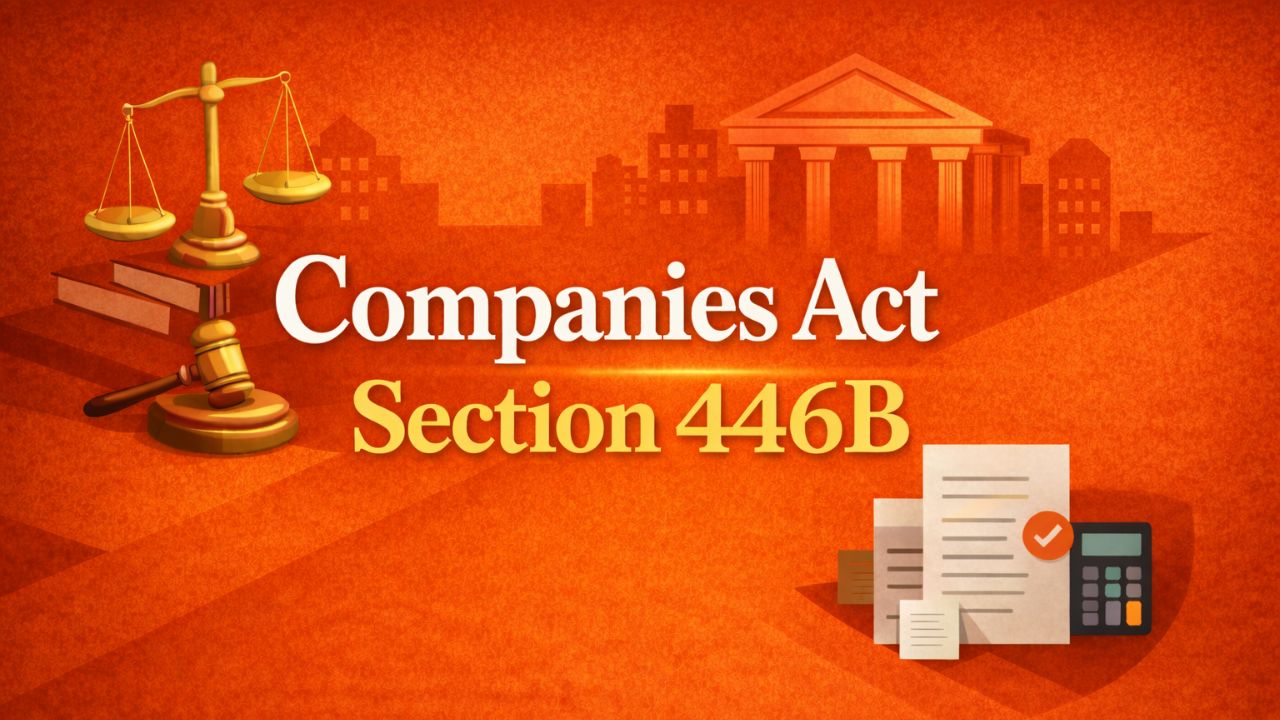
Companies Act, Section 446B: Lesser Penalties for Certain Types of Companies
Section 446B of the Companies Act, 2013 provides a beneficial and supportive provision designed to ease compliance burden on specific categories of companies that are generally smaller in scale or are newly established.
It recognizes that such entities may require more flexibility during their early or growing stages and should not be excessively penalized for minor non-compliance.
This provision promotes entrepreneurship, encourages small business growth, and ensures that penalties are proportionate to the size and operational capacity of such companies.
1. Reduced Penalty Structure for Eligible Entities
Despite the general penalty framework under the Companies Act, if any non-compliance or default occurs by the following types of companies:
One Person Company (OPC), Small Company, Start-up Company, Producer Company or by their Officers in default, or Any other person responsible for compliance then reduced penalties shall apply.
2. Extent of Penalty Reduction
The reduced penalty under this section is:
Not more than half of the penalty stated in the relevant provision of the Act. Subject to maximum limits as follows:
?2,00,000 (Two lakh rupees) for the company. ?1,00,000 (One lakh rupees) for each officer in default or any other responsible person.
This ensures that penalties remain fair, reasonable, and affordable for companies with limited financial capacity.
3. Purpose and Rationale Behind the Provision
This relaxation is provided to encourage compliance rather than punish minor lapses.
Support early-stage and smaller regulated entities, Reduce financial strain and operational disruption.
Promote a business-friendly regulatory environment, Foster innovation and entrepreneurship in India.
The law acknowledges that punitive penalties may discourage growth and investment, especially for companies still stabilizing their operations.
4. Explanation Clause: Definitions for Clarification
To eliminate ambiguity, the section clarifies the following:
a) Producer Company
Refers to a company defined under Section 378A(l) of the Act.
These are companies formed by producers engaged in activities such as farming, handloom, agriculture, etc., to improve their economic viability.
b) Start-up Company
Means a private company that is incorporated either under the Companies Act, 2013 or the Companies Act, 1956 is officially recognized as a start-up by the Central Government, specifically by the Department for Promotion of Industry and Internal Trade (DPIIT).
This ensures that only genuine start-ups registered under government initiatives enjoy reduced penalties.
5. Key Benefits of Section 446B
Promoting compliance culture rather than fear of punishment, Aligning legal measures with the Government’s Ease of Doing Business reforms.
Supporting grassroots enterprises and Start-up India mission, Enabling better focus on innovation, growth, and sustainability.
It serves as a positive legal incentive rather than a restrictive regulatory pressure.
© 2020 CREDENCE CORPORATE SOLUTIONS PVT. LTD. | Website by Wits Digtal Pvt. Ltd.









Leave a Comment