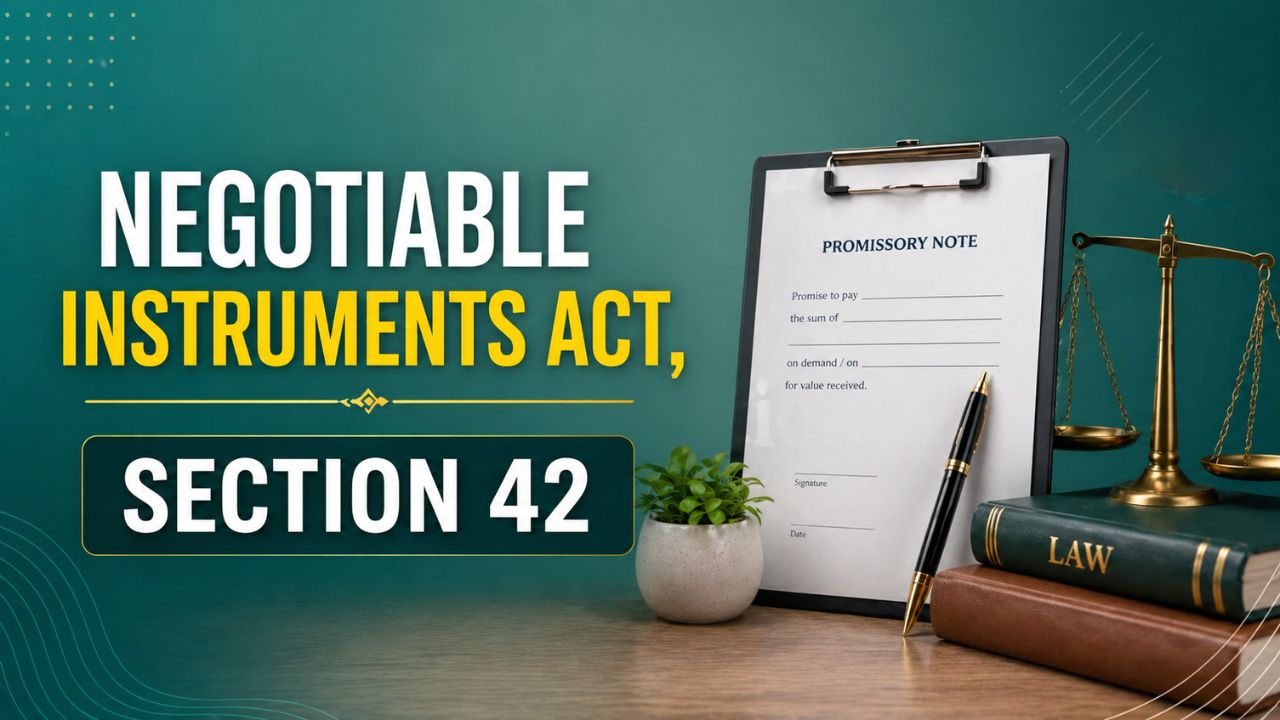
Negotiable Instruments Act, Section 42: Acceptance of Bill Drawn in Fictitious Name
Section 42 of the Negotiable Instruments Act, 1881 addresses the liability of an acceptor in situations where a bill of exchange is drawn in a fictitious name.
This provision safeguards the interests of a holder in due course and ensures that acceptance of such a bill cannot be avoided merely because the name of the drawer is fictitious.
1. Meaning of Bill Drawn in a Fictitious Name
A bill of exchange is said to be drawn in a fictitious name when the person named as the drawer does not actually exist or when the name used is not intended to represent a real person.
In such cases, the instrument appears valid on its face, but the drawer is not a genuine or identifiable individual.
Section 42 particularly applies where the bill is drawn in a fictitious name and is made payable to the drawer’s own order.
This means that the instrument requires endorsement by the drawer before it can be negotiated further.
2. Role of the Acceptor
The acceptor of a bill of exchange is the drawee who agrees to pay the amount specified in the bill at maturity.
By accepting the bill, the acceptor becomes primarily liable for payment. His liability is direct and independent of the liability of other parties.
The acceptor is expected to examine the instrument before acceptance and to act with due care and diligence.
3. Indorsement by the Same Hand as the Drawer’s Signature
Section 42 provides that if a bill drawn in a fictitious name is accepted and later comes into the hands of a holder in due course, the acceptor cannot escape liability merely because the drawer’s name was fictitious.
This protection applies where the bill is payable to the drawer’s order and the endorsement appears to be made by the same hand as the drawer’s signature.
In such circumstances, if a holder in due course claims under the endorsement, the acceptor remains liable even though the drawer’s name was fictitious.
4. Protection of Holder in Due Course
The provision is specifically designed to protect a holder in due course that is, a person who has obtained the instrument for value, in good faith, and without notice of any defect.
If such a holder receives the instrument with an endorsement that appears to be genuine and consistent with the drawer’s signature, he is entitled to rely on the validity of the acceptance.
The acceptor, having accepted the bill, cannot later deny liability on the ground that the drawer was fictitious.
5. Rationale of the Provision
The purpose of Section 42 is to preserve confidence in negotiable instruments and to prevent acceptors from avoiding responsibility by raising technical defenses related to fictitious names.
Since the acceptor undertakes primary liability upon acceptance, the law places the burden upon him to ensure the authenticity of the instrument before accepting it.
Once he has accepted, he cannot later rely on the fictitious nature of the drawer’s name to defeat the claim of a holder in due course.
6. Commercial Significance
This provision reinforces the principle that negotiable instruments must remain reliable in commercial circulation.
It ensures that innocent holders who acquire such instruments in good faith are protected against hidden defects.
By holding the acceptor liable despite the fictitious nature of the drawer’s name, the Act promotes certainty, stability, and trust in financial transactions.
© 2020 CREDENCE CORPORATE SOLUTIONS PVT. LTD. | Website by Wits Digtal Pvt. Ltd.









Leave a Comment